
TCI Technologies

IT Support That Just Works, for Long Island & NYC Businesses

We fix problems fast, keep your data safe from hackers, and give you a real person to call. Trusted since 2003.

Your Trusted IT Support Company at Scale

At TCI Technologies, we understand that your business can’t afford downtime or security risks. As a full-service IT support company, we specialize in delivering customized IT and cybersecurity solutions that scale with your business needs. Since 2003, we’ve helped businesses across Long Island, NYC, and the Tri-State area streamline their technology operations, providing reliable services that let you focus on what matters—handling your business.

null

Cloud IT Services

null

Managed IT Services

null

IT Project Management

null

Cyber Security Solutions

We Solve IT Pain Points, Not Create Them

We don’t just introduce technology; we provide solutions. From seamless cloud migrations and proactive maintenance to all-point cybersecurity strategies, we offer the expertise you need without confusing jargon or hidden fees.

IT support company Long Island
IT Support Company long island nyc

Human-Centered IT Support

IT support should simplify, not complicate, your business operations. That’s why we prioritize clear communication and building relationships with our clients. Whether you’re a small business or a large enterprise, we tailor your IT services to fit the specific goals you want to achieve. With us, you’re never left in the dark—we’re here to support you every step of the way.

Stay Ahead with Evolving Technology

Technology evolves fast, and your business needs to stay ahead of the curve. From ensuring cybersecurity compliance to empowering your remote workforce, TCI Technologies keeps your IT infrastructure up-to-date and secure. As a leading IT support company, we handle the complexities of technology so you can focus on whatever is most important to you.

Let us take the hassle out of IT with scalable, reliable solutions designed to help your company thrive.

Rated 4.9★ by 84 businesses on Google

Here’s what our clients say about working with TCI.

★★★★★

“The company I work for uses TCI to manage our computers and technical needs. Everyone there is always very helpful and patient especially with assistance on the remote connections. Kenita always solves any issues I have without any follow up and I highly recommend her and her team.”

Lindsay W.
Google review

★★★★★

“Great experience working with this IT company! Their team was professional, responsive, and resolved our issues quickly and efficiently. The process was smooth from start to finish, and their customer service was excellent. Highly recommend for anyone looking for reliable IT support.”

Keith W.
Google review

★★★★★

“Very friendly and knowledgeable of my questions. Patience of a saint. TCI and its team have proven to be a valuable investment for our organization. I ask questions and they are addressed in a timely manner.”

Elsa R.
Google review

Recent Posts

AI Security for Law Firms: Reducing Risk Through Governance

A recent Connecticut court case exposed a growing concern in AI security for law firms. A self-represented litigant hid instructions in tiny white text inside an electronic court filing. While invisible to attorneys reviewing the document, the text could still be read by AI systems and was designed to influence how the document was interpreted.

Connecticut Superior Court Judge Walter Spader Jr. identified the tactic as a prompt injection attempt and revoked the litigant's electronic filing privileges in the case.

While the incident may seem unusual, it highlights a broader challenge for law firms increasingly using AI for document review, legal research, and case preparation. Firms need confidence that the information provided to AI systems can be trusted.

Why AI Security Matters as Legal AI Adoption Grows

AI is quickly becoming a practical tool inside law firms. Attorneys are using AI to summarize documents, analyze contracts, review discovery, organize case materials, and accelerate research. Tasks that once required hours of manual review can often be completed in a fraction of the time.

According to Thomson Reuters, 41% of law firms reported using generative AI in 2026, compared with 28% in 2025. Among legal professionals already using AI tools, document review and document summarization remain two of the most common use cases.

As adoption grows, law firms need to consider how AI security fits into their existing risk management and client confidentiality practices. Like any technology, AI delivers the greatest value when it is supported by appropriate controls, oversight, and governance.

How Prompt Injection Attacks Can Impact Legal Workflows

AI systems process the information they receive, so content embedded within a document can influence how a summary, analysis, or recommendation is generated.

In a legal environment, even small inaccuracies can have consequences. A manipulated summary could:

  • Omit important facts
  • Downplay key arguments
  • Prioritize one side's position
  • Create misleading conclusions
  • Introduce information that was never intended to be part of the review process

The risk is not limited to white text. Security researchers have noted that content designed to influence AI can be hidden in metadata, comments, images, formatting elements, and other document components that may not be visible during a routine review.

As organizations increasingly adopt AI-powered workflows, addressing these risks is becoming an important part of AI governance and risk management.

Seven Ways to Strengthen AI Security for Law Firms

The good news is that securing AI workflows does not require reinventing existing processes. The same disciplines law firms rely on to protect confidential information, manage risk, and maintain trust can provide a strong foundation for responsible AI adoption.

1. Review Documents before AI Processing

External documents should go through a controlled intake process whenever possible. Hidden text, embedded objects, unusual metadata, and other non-visible content should be identified before documents are uploaded into AI platforms.

2. Separate Content from AI System Instructions

Approved AI systems should be configured to treat uploaded files as reference material, not as trusted commands. While this safeguard is not foolproof, it can help reduce the likelihood that embedded content influences the output.

3. Use Clean Copies of Documents

Creating clean copies of external documents before processing them through AI systems can help reduce unnecessary risk. Depending on the workflow, sanitation may involve removing metadata, comments, embedded objects, active content, or other hidden elements that do not contribute to the legal analysis.

4. Maintain Human Oversight

AI can accelerate legal work, but it should not replace professional judgment. Attorneys should validate important findings against the original source material before relying on AI-generated summaries or recommendations.

5. Limit Access and Permissions

Document-review tools should only have access to the information required to perform their intended function. AI-generated content should not automatically send messages, modify records, file documents, or retrieve confidential materials without human review and authorization.

6. Establish Clear AI Usage Policies

Employees need guidance on which AI platforms are approved, what information can be uploaded, and how outputs should be reviewed. Clear governance helps create consistency while supporting confidentiality, compliance, and accountability throughout the organization.

7. Test the Complete Workflow

AI security controls should be tested periodically using realistic examples that contain hidden content, misleading instructions, or other elements designed to influence AI-generated output. Testing can reveal weaknesses and help organizations continuously improve their processes.

Reducing AI Risk Through Governance

AI security for law firms should be viewed as part of a broader risk management strategy, not simply a technology initiative. The firms that gain the most value from AI will be those that implement it with the right security, governance, and oversight.

TCI Technologies helps law firms establish a framework for responsible AI adoption, combining practical technology guidance with cybersecurity expertise to help reduce risk, protect sensitive information, and support confident AI use.

Secure AI Adoption: How Businesses Can Embrace AI with Confidence

Artificial intelligence (AI) is becoming a practical tool for businesses looking to improve productivity, streamline operations, and support better decision-making. As more organizations integrate these solutions, questions around security, privacy, and governance naturally arise. Secure AI adoption helps ensure these tools are used responsibly, effectively, and with the right safeguards in place.

What is Managed AI Governance?

Managed AI governance is the ongoing process of defining how AI tools are approved, secured, monitored, and supported across an organization. It gives businesses a practical way to encourage AI use while reducing unnecessary risk.

Successful implementation requires more than choosing the right technology. Businesses also need clear policies, security controls, defined ownership, and ongoing governance.

The following framework provides a foundation for secure and responsible AI adoption.

Why Businesses Are Embracing AI

AI can help organizations reduce manual work, improve efficiency, and give employees more time to focus on higher-value responsibilities.

Businesses are using AI tools to:

    • Automate repetitive administrative tasks
    • Assist with content creation, reporting, and documentation
    • Support research, data analysis, and decision-making
    • Streamline internal workflows and improve information retrieval

When adopted thoughtfully, AI can become a valuable part of day-to-day operations. Realizing that value while managing risk requires secure, consistent, and responsible use.

Understanding the Risks of AI Adoption

AI offers significant benefits, but it also introduces security, privacy, and operational concerns.

Business leaders should consider:

    • How business data is protected within AI platforms
    • Whether platforms align with security, privacy, and compliance requirements
    • How user access and permissions are managed
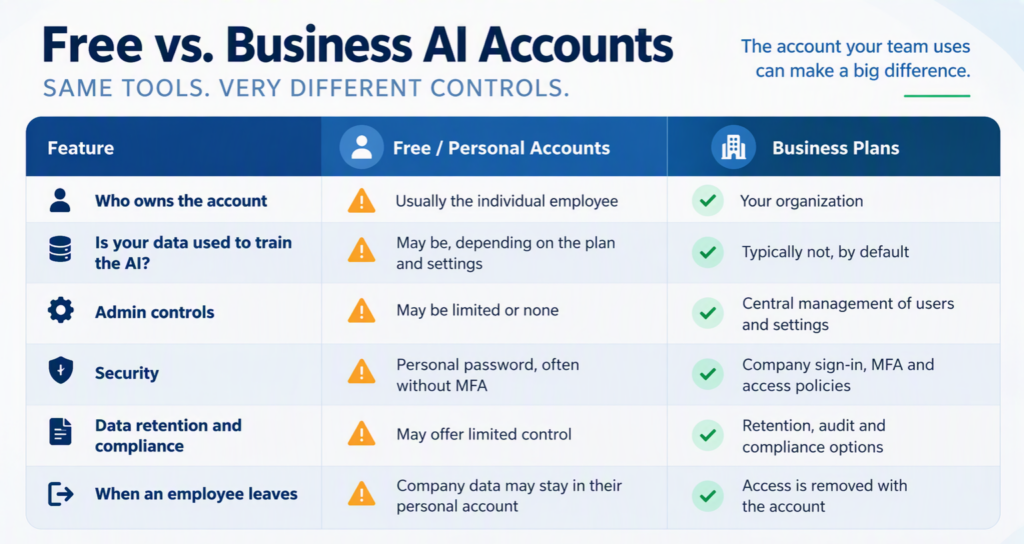
    • Who is responsible for administering AI accounts and licenses
    • Whether clear policies exist for responsible AI use
    • How AI platforms and integrations will be reviewed over time

AI platforms may interact with confidential client information, financial data, legal documents, employee records, and other sensitive business information.

These considerations should not prevent businesses from using AI. Instead, they reinforce the need for managed AI governance, appropriate security controls, and ongoing oversight.

What Secure AI Adoption Looks Like

dashboard of various charts for full oversight of AI usage, licenses, users, spend, and more.

Secure AI adoption begins with a governance framework that allows employees to use AI productively while helping the organization maintain visibility, accountability, and control.

Establish Clear AI Policies

An AI policy should define approved platforms, acceptable use, and what information should not be entered into AI tools. Policies should be reviewed regularly as technology, regulations, and business needs evolve.

Choose Appropriate Business Platforms

Not all AI platforms are designed for business use. Organizations should select solutions such as Microsoft 365 Copilot, ChatGPT Enterprise, and Claude for Enterprise that align with their security, compliance, and operational requirements while providing greater control over users, data, and access.

Protect Sensitive Information

Existing data protection practices should extend to AI platforms. Security configurations, role-based access, and account management help protect confidential business information.

Manage Access and Licensing

Organizations need a consistent process for managing users, permissions, and licenses. Centralized administration helps maintain account ownership, control costs, and manage approved integrations.

Provide Guidance and Support

Employees need practical guidance on approved uses, data protection requirements, and platform limitations. Ongoing support helps minimize disruptions and encourage responsible use.

Monitor and Review Your AI Framework

AI capabilities, business requirements, and regulatory expectations will continue to evolve. Regular governance reviews help organizations maintain security, compliance, and control as AI usage grows.

Turning AI Into a Long-Term Business Advantage

Secure AI adoption helps employees use AI effectively while reducing avoidable security, privacy, and operational risks through clear governance and responsible oversight.

TCI Technologies helps organizations implement the policies, controls, and accountability needed to manage AI with confidence and support long-term success.

Security Awareness Training: Your First Line of Defense Against Cyber Threats

In today's threat landscape, security awareness training is one of the most effective ways to reduce cyber risk and build a security-first culture. While tools like firewalls, multi-factor authentication (MFA), endpoint protection, and email security solutions help defend against threats, they can't stop every attack.

Employees interact with emails, websites, applications, and sensitive data every day, making them a critical part of your organization's security strategy. By teaching them how to recognize threats, avoid scams, and respond appropriately, organizations can make security a daily habit.

A layered approach that combines professional cybersecurity services with security awareness training creates a stronger defense against today's evolving threats.

What is a Security-First Culture?

A security-first culture is one where cybersecurity is part of everyday decision-making, not just the responsibility of the IT department.

It’s built through:

    • Ongoing security awareness training
    • Phishing simulations and real-world practice
    • Clear policies and procedures
    • Leadership support and accountability
    • Open communication about cyber risks

When employees understand their role in protecting the organization, security becomes everyone's responsibility, not just the IT team.

Why a Security-First Culture Matters for Your Organization

Many cyberattacks begin with a simple mistake, such as clicking a malicious link, responding to a phishing email, or sharing sensitive information with the wrong person.

While cybersecurity tools help identify and block threats, employees remain one of the organization's most important lines of defense. Ongoing security awareness training helps teams recognize warning signs and respond appropriately before a threat becomes an incident.

Six Benefits of Security Awareness Training

Building a security-first culture begins with leadership commitment and ongoing employee education. When security awareness becomes part of everyday operations, employees develop habits that help reduce risk and protect the organization.

Here are six ways security awareness training strengthens your business beyond technology alone.

1. Supports Cyber Insurance Requirements

Many cyber insurance providers now require organizations to demonstrate ongoing security awareness training as part of their risk management strategy.

2. Strengthens Compliance Audit Readiness

Regular security awareness training can help support compliance efforts by showing that employees receive ongoing education about cybersecurity risks and best practices.

3. Builds Understanding and Accountability

Training helps employees understand how their actions affect organizational security while encouraging greater accountability across the organization.

4. Reduces Cyber Risk and Human Error

Educated employees are more likely to identify suspicious activity, avoid scams, and follow established security procedures.

5. Speeds Up Incident Response

When employees know what to look for and when to report concerns, potential security incidents can be addressed more quickly.

6. Creates Long-Term Resilience

An organization with a strong security-first culture is better prepared to adapt to evolving threats and recover from incidents when they occur.

What Makes Security Awareness Training Effective?

employee receiving security awareness training email

Regular Training Sessions

Short, relevant lessons are easier to complete and more likely to be remembered.

Effective training uses real-world scenarios to help employees recognize and respond to common cyber threats.

Phishing Simulations

Phishing remains one of the most common attack methods used by cybercriminals.

Simulated phishing campaigns allow employees to practice identifying suspicious emails in a safe environment, helping them build confidence and sharpen their instincts.

Measure Engagement, Not Just Mistakes

The goal of security awareness training isn't perfection—it's continuous improvement. Instead of focusing solely on who clicked a link, look for positive behaviors such as:

    • Employees reporting suspicious emails
    • Participation in training programs
    • Questions about cybersecurity best practices
    • Increased awareness over time

These metrics provide a clearer picture of how security habits are improving across the organization.

Empower Your Team with Security Awareness Training

Building a security-first culture requires more than technology. It depends on employees who can recognize threats, make informed decisions, and respond appropriately when something doesn't look right.

Start building your security awareness program today and empower employees to become your organization's first line of defense.

take a proactive approach to IT security

Get in Touch with TCI Today!

It’s time to hire a managed IT services provider who knows what they’re doing and actually cares about your company’s success.